Turkey has banned the gaytor.rent
-
Unfortunately, today, 12 May 2026, Turkey has blocked access to the gaytor.rent domain. As a result, there is no access to the tracker, so downloads and uploads are not possible.

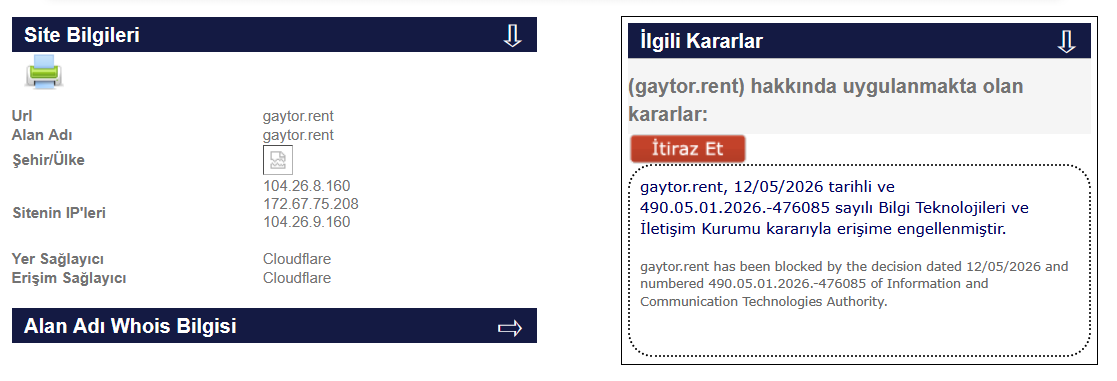
-
vpn works?
-
The only option for places like this would be to use a VPN to get around the blocks. Just make sure that you use a VPN that supports port forwarding, as this is essential to being able to get proper upload traffic.
-
@LEandros if you don't have a VPN, you can try using AdGuard DNS. You can set a DNS IP manually in your adapter's settings or you can just install the AdGuard app in your PC.
When you try to visit a site from its domain (gaytor.rent) it needs to be translated into a real IP address, if you don't use a custom DNS provider you will be using your own ISP's DNS, which is subject to government censorship.
-
@ianfontinell Custom DNS will only work if the country you are in and the provider you are using does not have/use a DPI system. If DPI is involved, even changing your DNS to a public DNS is not enough. Canada is a perfect example of this. When the Canadian government bans certain sites or domains (which DOES happen), the big player providers in the market (who basically own a monopoly) make use of a DPI system, so even if you try using Google DNS, the moment you try to do anything with a banned domain, the request will fail. The ONLY way around this is to use a VPN AND Tor as for most of these blocks (at least in a DPI state like Canada), a VPN alone is not enough.
-
The UK's Labour gov wants to ban the use of VPNs. What would be the workaround if they bring that in?
-
@raphjd That depends on a couple of things... The first is if they run a DPI system, and if so, how elaborate it is. The second has to do with the kind of VPN that you use.
If they have a DPI that goes really in depth, it may not be possible to get around it, as the DPI will eventually detect the use of a VPN (regardless of the workaround) and start dropping the packets.
If the DPI (like most of the world that has it) only looks at the more basic details of the connection, then there are still two potential ways in which you can get around this.
The first is that services like the one I use offer what is known as stealth VPN, which usually does slow down the VPN connection some, however skirts around the usual restrictions by using DNS overrides in their app, as well as using one of two ports that would more or less break the entire internet if they were to filter said traffic. TCP 443 is the most common port to use for stealth VPN, as you cannot restrict this port without breaking the vast majority of the internet.
The second (which my provider supports for countries like China) is very similar to the first, only the stealth VPN also uses a different hostname on a different domain, as well as a different IP address on a different subnet to sneak under the radar of the more sensitive DPI systems.
In the case of Canada, if the Canadian government does succeed in banning the use of a VPN, this could get very tricky for a lot of us, it is a lot more complicated to fly under the radar. In the case of a service such as GoldTV, which was banned some time ago, the only way it can be accessed in Canada is with both the use of a VPN AND Tor together, as the DPI can still sniff out the DNS and destination IP of the packet, even through pretty well all VPN services.
-
@raphjd It should also be noted that for most of the world, when a government blocks the use of a site or service, these blocks do not usually go beyond basic DNS interception, so that even if you're using a DNS server other than your provider's, it will sniff out requests for certain banned domains or keywords, then drop the packets.
Blocking the use of a VPN is usually done either the exact same way (so you can just use a service or host on a domain they don't know about yet), or more commonly, is restricted by protocol type and destination port. In the case of the more common port restrictions, using an alternate port (even without the use of stealth VPN) such as TCP 443 will get around this in a jiffy.
Most networks that I've encountered that block the use of VPN traffic do so either by specifically blocking the default ports for VPN services, or in some cases, have a blanket policy to only allow certain ports, and deny everything else. In the case of either of these two methods, using TCP 443 will get around this as any website that uses HTTPS uses TCP 443, so if you block this port, you basically kill like 99% of the internet.
-
Thank you all for your kind suggestions. I’m already using a VPN. I just wanted to share the news. However, until yesterday, when I wanted to leave my computer on solely for torrenting to get the maximum speed, I would connect without a VPN. That won’t be possible anymore.
-
@LEandros This explains why I wasn't able to download and all my seedings went in red.

-
Thank you all for your kind suggestions. I’m already using a VPN. I just wanted to share the news. However, until yesterday, when I wanted to leave my computer on solely for torrenting to get the maximum speed, I would connect without a VPN. That won’t be possible anymore.
@LEandros which VPN are you using? Does it allow you to download? Ca?n you please tell me which vpn you are using
-
@VONCROFT16 I use PrivateVPN from PrivateVPN.com
They support Windows, MacOS, Linux, Android, and iOS. They also have a strict no logging policy, so if someone approaches them with a legal request to disclose your information, they can honestly respond by informing that person that they cannot disclose information they do not have.
As a bonus, they also support port forwarding of one port on all server locations, except for the locations that forward ALL ports. If your provider uses a high grade DPI to try to intercept or otherwise kill VPN traffic, they also offer a stealth option so that you can fly under the radar of the DPI and go about your business anyway.

The only difference between martyrdom and suicide is press coverage! -
@VONCROFT16 I use PrivateVPN from PrivateVPN.com
They support Windows, MacOS, Linux, Android, and iOS. They also have a strict no logging policy, so if someone approaches them with a legal request to disclose your information, they can honestly respond by informing that person that they cannot disclose information they do not have.
As a bonus, they also support port forwarding of one port on all server locations, except for the locations that forward ALL ports. If your provider uses a high grade DPI to try to intercept or otherwise kill VPN traffic, they also offer a stealth option so that you can fly under the radar of the DPI and go about your business anyway.
thank you
-
-
@raphjd I don't know about on stealth VPN, as I don't generally need to use it, but I know that most server locations that they have I'm able to easily crank at LEAST 100 mbit symmetrical through them.



Hello! It looks like you're interested in this conversation, but you don't have an account yet.
Getting fed up of having to scroll through the same posts each visit? When you register for an account, you'll always come back to exactly where you were before, and choose to be notified of new replies (either via email, or push notification). You'll also be able to save bookmarks and upvote posts to show your appreciation to other community members.
With your input, this post could be even better 💗
Register Login